Note
Access to this page requires authorization. You can try signing in or changing directories.
Access to this page requires authorization. You can try changing directories.
Applies to: Azure Logic Apps (Standard)
When your integration scenario needs custom tasks or logic beyond the built-in operations and connectors in Azure Logic Apps, create and run .NET code as custom functions in your Standard workflows. Your workflow can then perform tasks such as custom parsing, validation, or even apply business rules. By using this capability, you can implement scenarios such as the following tasks:
- Customize business logic implementation.
- Customize parsing to extract information from an inbound message.
- Perform data validation and simple transformations.
- Perform calculations.
- Shape outbound messages sent to another system, such as an API.
This guide shows how to write and run your own .NET code directly in Standard workflows by using Visual Studio Code. You learn how to create, debug, and deploy local functions by using Visual Studio Code so you can keep custom code and workflow orchestration together, debug them in one session, and deploy them as a single solution.
Note
Custom inline .NET code isn't suitable for the following scenarios:
- Running processes that might exceed 10 minutes.
- Attempting large message and data transformations.
- Performing complex batching and debatching scenarios.
- Using BizTalk server pipeline components that implement streaming.
For more information, see Limitations.
Prerequisites
An Azure account and subscription. Get a free Azure account.
The most recent Visual Studio Code with the Azure Logic Apps (Standard) extension.
For prerequisites, see Create Standard workflows in single-tenant Azure Logic Apps with Visual Studio Code.
The extension provides the following capabilities and benefits:
- Write your own code by creating functions that have the flexibility and control to solve your most challenging integration problems.
- Debug code locally in Visual Studio Code. Step through your code and workflows in the same debugging session.
- Deploy code alongside your workflows. No other service plans are necessary.
- Support BizTalk Server migration scenarios so you can lift and shift custom .NET investments from on premises to the cloud.
A local folder to use for your code project.
Limitations
You can use the custom functions capability only in Visual Studio Code running on Windows. This capability supports using .NET Framework and .NET 8 for Standard logic app workflows deployed and hosted on Azure.
You can't use custom functions authoring in the Azure portal. However, to work with outputs from custom functions in your workflow, follow these steps:
After you deploy your functions to Azure, follow the steps in Call your code from a workflow for the Azure portal.
Add the built-in action named Call a local function in this logic app to your workflow. Select the deployed custom functions you want and run your code.
Use subsequent workflow actions to reference the custom function outputs, like you can in any other workflow. You can view the built-in action's run history, inputs, and outputs.
For general limitations, see Limits and configuration reference for Azure Logic Apps.
1: Create a code project
The Azure Logic Apps (Standard) extension for Visual Studio Code includes a code project template that provides a streamlined experience for writing, debugging, and deploying your own code with your workflows. This project template creates a workspace file and two sample projects: one project to write your code and another project to create your workflows.
Note
You can't use the same project folder for both your code and workflows.
To create a code project, follow these steps:
In Visual Studio Code, sign in to your Azure account.
If sign in takes longer than usual, Visual Studio Code prompts you to sign in through a Microsoft authentication website by providing you with a device code. To sign in by using the code instead, follow these steps:
Select Use Device Code, and then select Copy & Open.
Select Open Link to open a new browser window and continue to the authentication website.
On the Sign in to your account page, enter your authentication code, and select Next.
On the Activity Bar, select the Azure icon.
In the Azure window, go to the Workspace section. Move your pointer over the title area so that the toolbar appears.
From the Azure Logic Apps menu, select Create new logic app workspace.
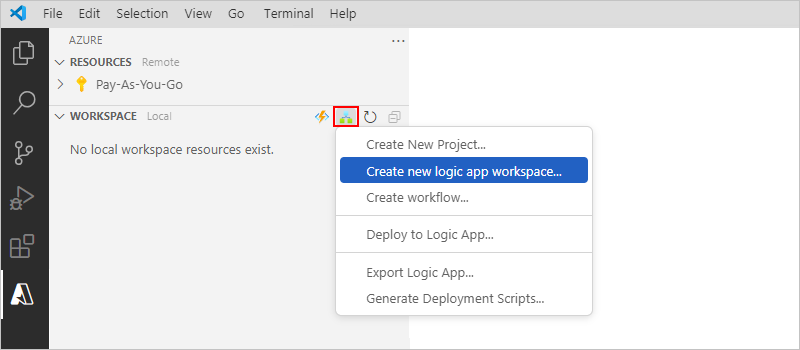
In the Select Folder window, browse to the local project folder, select the folder, and then Select.
In the Create new logic app workspace window, for the Workspace name prompt, enter a name for your workspace, and then press Enter.
This example uses
weather-appas the workspace name:
This example uses
weather-projectas the workspace name.For the Select a template for your new project prompt, select Logic app with custom code project.
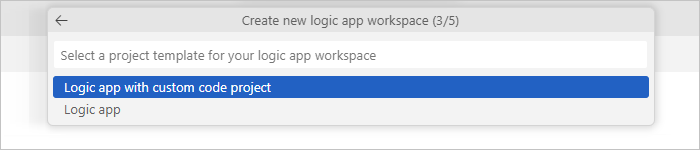
For the Select a target framework prompt, select either .NET Framework or .NET 8.
Follow the subsequent prompts to provide the following information:
Prompt Example value Logic App name weather-logic-appFunction name for your .NET functions project WeatherForecastNamespace for your .NET functions project Contoso.EnterpriseSelect a template for your project's first workflow:
- Stateful workflow
- Stateless workflow
- Autonomous agent
- Conversational agent
- Skip for nowStateful workflow Workflow name weather-workflowFor the Select how you would like to open your project prompt, select Open in current window.
After you finish this step, Visual Studio Code creates your workspace, which includes a .NET functions project and a logic app project, by default, for example:
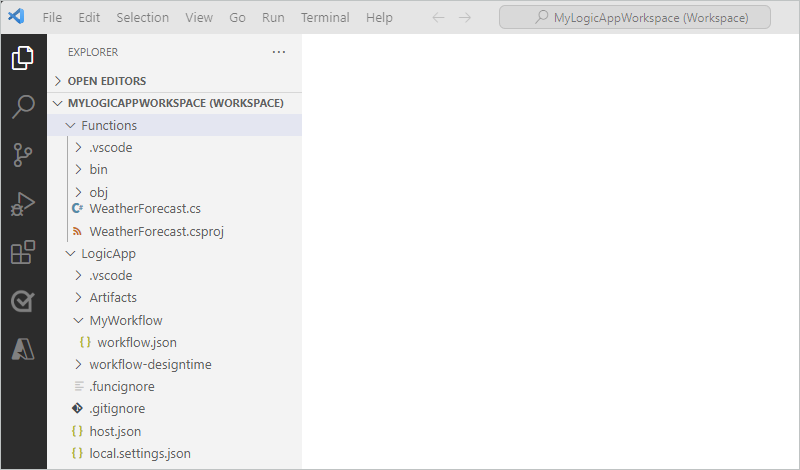
In the Explorer window, note the following folders in your workspace:
Folder Description <workspace-name> Contains both your .NET functions project and logic app workflow project. <logic-app-name> Contains the files and other artifacts for your logic app project. For example, the workflow.json file is the workflow definition file where you can build your workflow. <function-name> Contains the files and other artifacts for your .NET functions project. For example, the <function-name>.cs file is the code file where you can author your code. For the Enable connectors for Azure for Logic Apps <logic-app-name> prompt, select Use connectors from Azure.
For the Select subscription prompt, select the Azure subscription you want.
For the Select a resource group for new resources prompt, select the resource group you want or Create new resource group.
For the Select a location for new resources prompt, select the Azure region for deployment.
For the Select authentication method for Azure connectors, select the authentication type to use for connections that need authentication.
Authentication type Description Managed identity Select Managed Service Identity to use the system-assigned or user-assigned identity on your logic app resource.
By default, Standard logic app resources already have the system-assigned identity enabled. However, you need to set up the identity with role access on the target resource plus any other requirements.
For more information, see Assign role-based access to a managed identity.Connection keys Set up access to the target resource by using connections strings and access keys.
After you complete these steps, continue to the next section so you can author your code.
2: Write your code
In the Explorer window, expand the function project folder, and open the <function-name>.cs file.
This file contains sample code and specific code elements with values you previously provided.
In this example, the WeatherForecast.cs function file contains these code elements with example values:
Code element Value Namespace name Contoso.EnterpriseClass name WeatherForecastFunction name WeatherForecastFunction parameters zipcode,temperatureScaleReturn type TaskComplex type WeatherThe following example shows the complete sample code:
//------------------------------------------------------------
// Copyright (c) Microsoft Corporation. All rights reserved.
//------------------------------------------------------------

namespace Contoso.Enterprise
{
    using System;
    using System.Collections.Generic;
    using System.Threading.Tasks;
    using Microsoft.Azure.Functions.Extensions.Workflows;
    using Microsoft.Azure.WebJobs;
    using Microsoft.Extensions.Logging;

    /// <summary>
    /// Represents the WeatherForecast flow invoked function.
    /// </summary>
    public class WeatherForecast
    {

        private readonly ILogger<WeatherForecast> logger;

        public WeatherForecast(ILoggerFactory loggerFactory)
        {
            logger = loggerFactory.CreateLogger<WeatherForecast>();
        }

        /// <summary>
        /// Executes the logic app workflow.
        /// </summary>
        /// <param name="zipCode">The zip code.</param>
        /// <param name="temperatureScale">The temperature scale (e.g., Celsius or Fahrenheit).</param>
        [FunctionName("WeatherForecast")]
        public Task<Weather> Run([WorkflowActionTrigger] int zipCode, string temperatureScale)
        {

            this.logger.LogInformation("Starting WeatherForecast with Zip Code: " + zipCode + " and Scale: " + temperatureScale);

            // Generate random temperature within a range based on the temperature scale
            Random rnd = new Random();
            var currentTemp = temperatureScale == "Celsius" ? rnd.Next(1, 30) : rnd.Next(40, 90);
            var lowTemp = currentTemp - 10;
            var highTemp = currentTemp + 10;

            // Create a Weather object with the temperature information
            var weather = new Weather()
            {
                ZipCode = zipCode,
                CurrentWeather = $"The current weather is {currentTemp} {temperatureScale}",
                DayLow = $"The low for the day is {lowTemp} {temperatureScale}",
                DayHigh = $"The high for the day is {highTemp} {temperatureScale}"
            };

            return Task.FromResult(weather);
        }

        /// <summary>
        /// Represents the weather information for WeatherForecast.
        /// </summary>
        public class Weather
        {
            /// <summary>
            /// Gets or sets the zip code.
            /// </summary>
            public int ZipCode { get; set; }

            /// <summary>
            /// Gets or sets the current weather.
            /// </summary>
            public string CurrentWeather { get; set; }

            /// <summary>
            /// Gets or sets the low temperature for the day.
            /// </summary>
            public string DayLow { get; set; }

            /// <summary>
            /// Gets or sets the high temperature for the day.
            /// </summary>
            public string DayHigh { get; set; }
        }
    }
}
The function definition includes a default
Runmethod that you can use to get started. This sampleRunmethod demonstrates some capabilities available with the custom functions feature, such as passing different inputs and outputs, including complex .NET types.The <function-name>.cs file also includes the
ILoggerinterface that provides support for logging events to an Application Insights resource. You can send tracing information to Application Insights and store that information with the trace information from your workflows, for example:private readonly ILogger<WeatherForecast> logger; public WeatherForecast(ILoggerFactory loggerFactory) { logger = loggerFactory.CreateLogger<WeatherForecast>(); } [FunctionName("WeatherForecast")] public Task<Weather> Run([WorkflowActionTrigger] int zipCode, string temperatureScale) { this.logger.LogInformation("Starting WeatherForecast with Zip Code: " + zipCode + " and Scale: " + temperatureScale); <...> }Replace the sample function code with your own, and edit the default
Runmethod for your specific scenarios. Or, you can copy the function, including the[FunctionName("<function-name>")]declaration, and then rename the function with a unique name. You can then edit the renamed function to meet your needs.
This example continues with the original sample code, assuming no changes.
3: Compile and build your code
After you finish writing your code, compile it to make sure that no build errors exist. Your .NET functions project automatically includes build tasks, which compile and add your code to the lib\custom folder in your logic app project where workflows look for custom functions to run. Depending on your .NET version, these tasks put the assemblies in the lib\custom\net472 or lib\custom\net8 folder.
Follow these steps:
In Visual Studio Code, on the Activity Bar, select Explorer.
In the Explorer window, open the shortcut menu for the functions project folder, and select Build functions project.
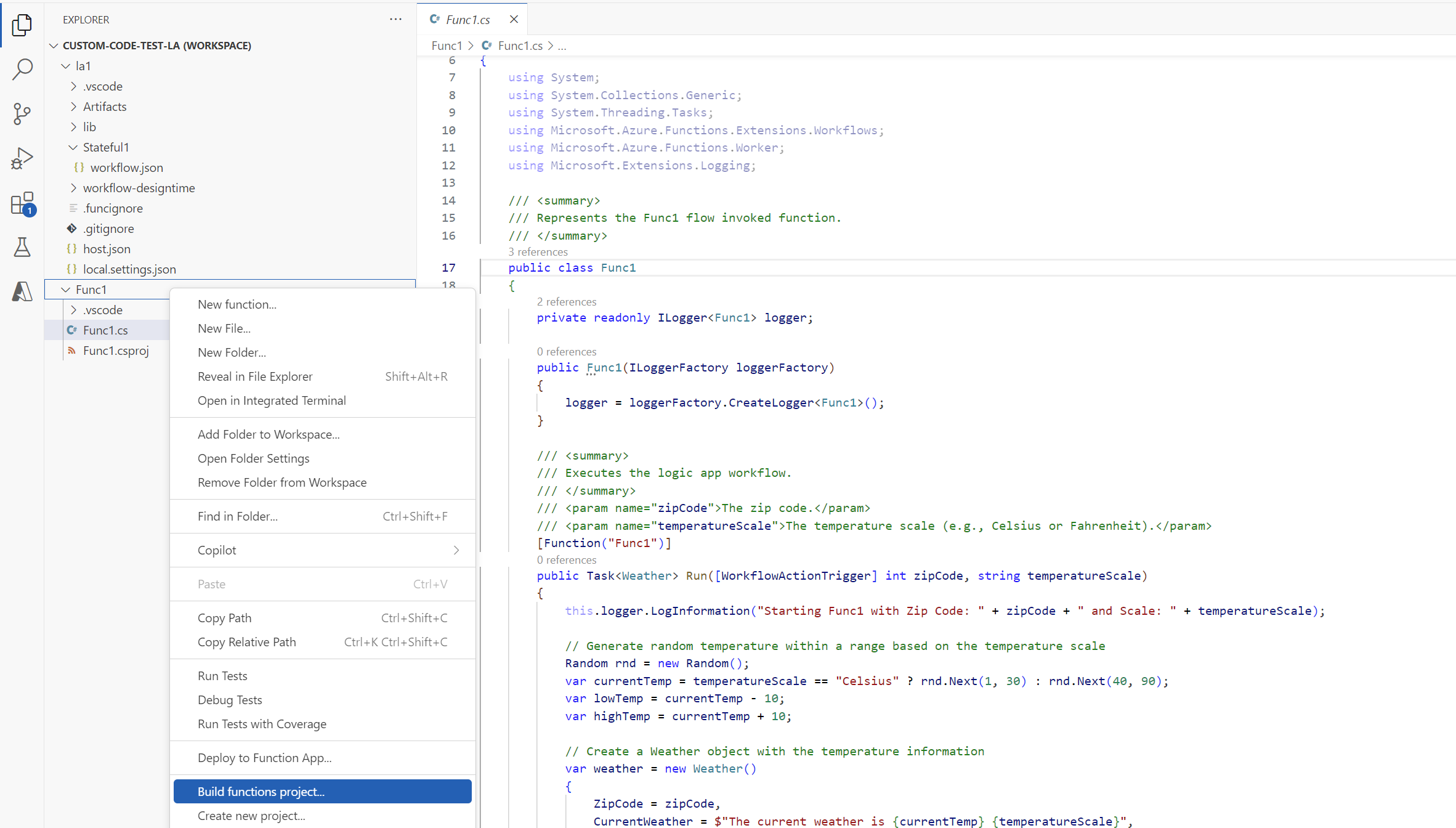
The build task runs for the functions project. If your build succeeds, the Terminal window shows a Build succeeded message.
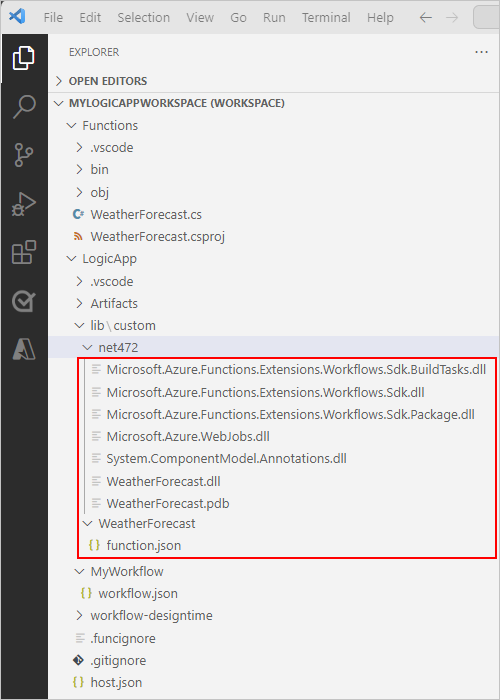
Confirm that the following items exist in your logic app project:
In your workspace, expand the following folders: <your-logic-app> > lib\custom > net472 or net8, based on your .NET version. Confirm that the subfolder named net472 or net8 contains the assembly (DLL) files required to run your code, including a file named <function-name>.dll.
In your workspace, expand the following folders: <your logic app> > lib\custom > <function-name>. Confirm that the subfolder named <function-name> contains a function.json file, which includes the metadata about the function code that you wrote. The workflow designer uses this file to determine the necessary inputs and outputs when calling your code.
The following example shows sample generated assemblies and other files in the logic app project:
4: Call your code from a workflow
After you confirm that your code compiles and your logic app project contains the necessary files for your code to run, set up your workflow to call your code.
In the Explorer window, expand <workspace-name>, <logic-app-name>, and then <workflow-name>.
Open the shortcut menu for workflow.json, and select Open designer.
The workflow designer opens and shows the default workflow with the following trigger and actions:
Operation Description Trigger The built-in Request trigger named When a HTTP request is received. Action The built-in action named Call a local function in this logic app. Action The built-in Response action named Response that you use to reply to the caller only when you use the Request trigger. On the designer, select the action named Call a local function in this logic app.
The action's information pane opens so you can set up the custom function call, for example:
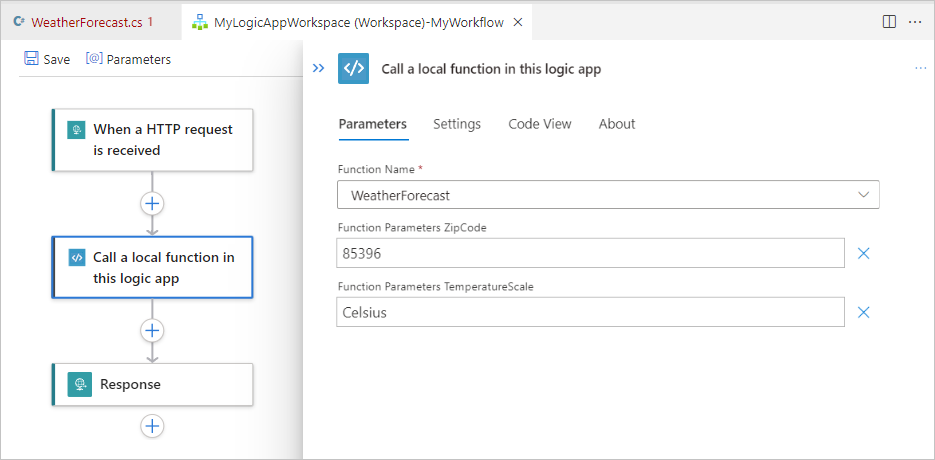
Review and confirm that the Function name parameter value is set to the function that you want to run. Review or change any other parameter values that your function uses.
5: Debug your code and workflow
For each of the following Azure Storage services, start the Azurite storage emulator:
- Azure Blob Service
- Azure Queue Service
- Azure Table Service
From the Visual Studio Code View menu, select Command Palette.
At the prompt that appears, select Azurite: Start Blob Service from the list.
From the working directory list that appears, select your logic app.
Repeat these steps for Azurite: Start Queue Service and Azurite: Start Table Service.
If you're successful, the Visual Studio Code taskbar at the bottom of the screen shows the three storage services running.
Attach the debugger to both your logic app project and .NET functions project by following these steps:
In Visual Studio Code, on the Activity Bar, select Run and Debug (keyboard: Ctrl+Shift+D).
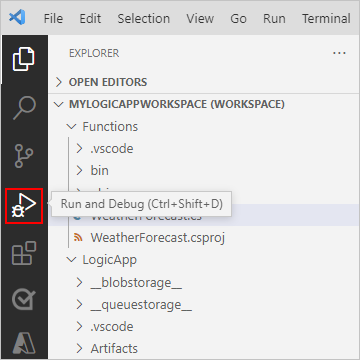
From the Run and Debug list, select Run/Debug logic app with local function (<your logic app>), and then select Play (green arrow).

The following events occur:
- The Terminal window opens and shows the started debugging process.
- The Debug Console window open and shows the debugging status.
- At the bottom of Visual Studio Code, the task bar turns orange, indicating that the .NET debugger is loaded.
To set any breakpoints, in your function definition (<function-name>.cs) or workflow definition (workflow.json), find the line number where you want the breakpoint, and select the adjacent column, for example:

To manually run the Request trigger in your workflow, open the workflow's Overview page:
From your logic app project, open the workflow.json file's shortcut menu, and then select Overview.
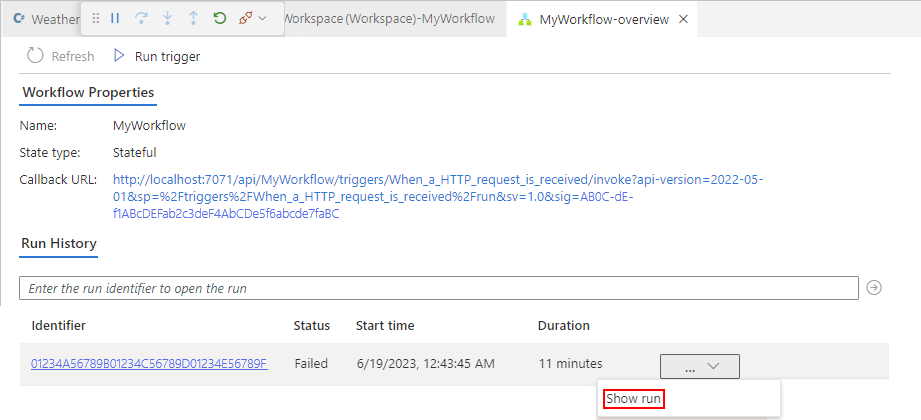
On the workflow's Overview page, the Run trigger button is available for when you want to manually start the workflow. Under Workflow Properties, the Callback URL value is the URL for a callable endpoint that's created by the Request trigger in your workflow. You can send requests to this URL to trigger your workflow from other apps, including other logic app workflows.
On the Overview page toolbar, select Run trigger.

After your workflow starts to run, the debugger activates your first breakpoint.
On the Run menu or debugger toolbar, select a debug action.
After the workflow run completes, the Overview page shows the finished run and basic details about that run.
To review more information about the workflow run, select the finished run. Or, from the list next to the Duration column, select Show run.
6: Deploy your code
Deploy your custom functions the same way you deploy your logic app project. Whether you deploy from Visual Studio Code or use a CI/CD DevOps process, make sure that you build your code before you deploy it. Also, ensure that all dependent assemblies exist in the following logic app project folder before you deploy:
.NET 4.7.2: lib/custom/net472 folder
.NET 8: lib/custom/net8 folder
For more information, see Deploy Standard workflows from Visual Studio Code to Azure.
Troubleshoot problems
Action information pane error
On the workflow designer, when you select the built-in action named Call a local function in this logic app, the action's information pane shows the following message:
Failed to retrieve dynamic inputs. Error details:
In this scenario, check your logic app project to see if the LogicApp\lib\custom folder is empty. If it's empty, from the Terminal menu, select Run Task > build Functions.
No process with the specified name is currently running
If you get this error message when you run your workflow, you likely attached the debugger process to .NET Functions, rather than to your logic app.
To fix this problem, from the Run and Debug list, select Attach to logic app (LogicApp), and then select Play (green triangle).
Package not imported correctly
If the Output window shows an error similar to the following message, make sure that you have at least .NET 6.0 installed. If you have this version installed, try uninstalling and then reinstalling.
C:\Users\yourUserName\.nuget\packages\microsoft.net.sdk.functions\4.2.0\build\Microsoft.NET.Sdk.Functions.targets(83,5): warning : The ExtensionsMetadataGenerator package was not imported correctly. Are you missing 'C:\Users\yourUserName\.nuget\packages\microsoft.azure.webjobs.script.extensionsmetadatagenerator\4.0.1\build\Microsoft.Azure.WebJobs.Script.ExtensionsMetadataGenerator.targets' or 'C:\Users\yourUserName\.nuget\packages\microsoft.azure.webjobs.script.extensionsmetadatagenerator\4.0.1\build\Microsoft.Azure.WebJobs.Script.ExtensionsMetadataGenerator.props'? [C:\Desktop\...\custom-code-project\MyLogicAppWorkspace\Function\WeatherForecast.csproj] WeatherForecast -> C:\Desktop\...\custom-code-project\MyLogicAppWorkspace\Function\\bin\Debug\net472\WeatherForecast.dll C:\Users\yourUserName\.nuget\packages\microsoft.net.sdk.functions\4.2.0\build\Microsoft.NET.Sdk.Functions.Build.targets(32,5): error : It was not possible to find any compatible framework version [C:\Desktop\...\custom-code-project\MyLogicAppWorkspace\Function\WeatherForecast.csproj] C:\Users\yourUserName\.nuget\packages\microsoft.net.sdk.functions\4.2.0\build\Microsoft.NET.Sdk.Functions.Build.targets(32,5): error : The specified framework 'Microsoft.NETCore.App', version '6.0.0' was not found. [C:\Desktop\...\custom-code-project\MyLogicAppWorkspace\Function\WeatherForecast.csproj] C:\Users\yourUserName\.nuget\packages\microsoft.net.sdk.functions\4.2.0\build\Microsoft.NET.Sdk.Functions.Build.targets(32,5): error : - Check application dependencies and target a framework version installed at: [C:\Desktop\...\custom-code-project\MyLogicAppWorkspace\Function\WeatherForecast.csproj]
Build failures
If your function doesn't include variables, and you build your code, the Output window might show the following error messages:
C:\Users\yourUserName\...\custom-code-project\Function\func.cs (24,64): error CS1031: Type expected [C:\Users\yourUserName\...\custom-code-project\Function\func.csproj]
C:\Users\yourUserName\...\custom-code-project\Function\func.cs (24,64): error CS1001: Identifier expected [C:\Users\yourUserName\...\custom-code-project\Function\func.csproj]
Build FAILED.
C:\Users\yourUserName\...\custom-code-project\Function\func.cs (24,64): error CS1031: Type expected [C:\Users\yourUserName\...\custom-code-project\Function\func.csproj]
C:\Users\yourUserName\...\custom-code-project\Function\func.cs (24,64): error CS1001: Identifier expected [C:\Users\yourUserName\...\custom-code-project\Function\func.csproj]
0 Warning(s)
2 Error(s)
To fix this problem, in your code's Run method, append the following parameter:
string parameter1 = null
The following example shows how the Run method signature appears:
public static Task<Weather> Run([WorkflowActionTrigger] int zipCode, string temperatureScale, string parameter1 = null)