Hello,
When I execute the following MDX query, I get this error:
Internal error: An unexpected error occurred (file 'mdmodelmd.cpp', line 2669, function 'MDModelMD::DecodeRelAttr').
What does this error mean and how can I avoid this?
The intent of the query is to obtain a table like this:
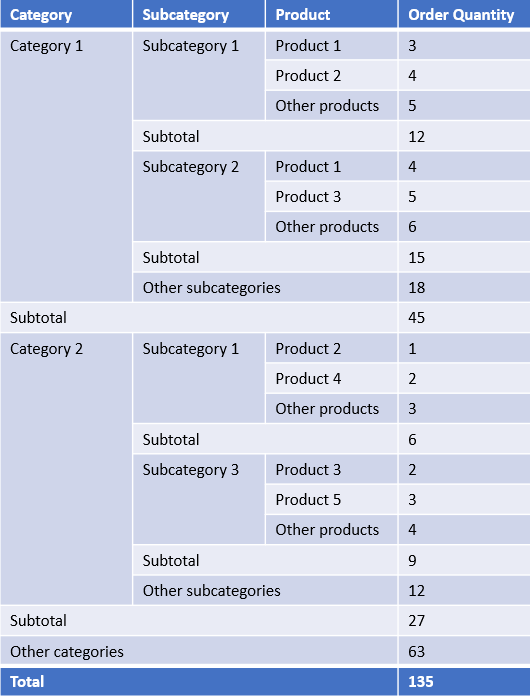
*The query results are sorted afterwards.
WITH

// top

SET top_category AS TOPCOUNT( [Product].[Category].[Category].Members, 2, [Measures].[Order Quantity] )

SET top_subcategory AS GENERATE(
	top_category,
	TOPCOUNT( ([Product].[Category].CurrentMember) * [Product].[Subcategory].[Subcategory].Members, 2, [Measures].[Order Quantity] )
)

SET top_product AS GENERATE(
	top_subcategory,
	TOPCOUNT( ([Product].[Category].CurrentMember, [Product].[Subcategory].CurrentMember) * [Product].[Product].[Product].Members, 2, [Measures].[Order Quantity] )
)

// all

SET all_category AS {[Product].[Category].[All Products]}

SET all_subcategory AS top_category * {[Product].[Subcategory].[All Products]}

SET all_product AS top_subcategory * {[Product].[Product].[All Products]}

// other

SET all_category_ AS [Product].[Category].[Category].Members
MEMBER [Product].[Category].[other_category] AS AGGREGATE( all_category_ - top_category )
SET other_category AS [Product].[Category].[other_category]

SET all_subcategory_ AS top_category * [Product].[Subcategory].[Subcategory].Members
MEMBER [Product].[Subcategory].[other_subcategory] AS AGGREGATE(
	EXISTS(all_subcategory_,([Product].[Category].CurrentMember))
	- EXISTS(top_subcategory,([Product].[Category].CurrentMember))
)
SET other_subcategory AS top_category * [Product].[Subcategory].[other_subcategory]

SET all_product_ AS top_subcategory * [Product].[Product].[Product].Members
MEMBER [Product].[Product].[other_product] AS AGGREGATE(
	EXISTS(all_product_,([Product].[Category].CurrentMember, [Product].[Subcategory].CurrentMember))
	- EXISTS(top_product,([Product].[Category].CurrentMember, [Product].[Subcategory].CurrentMember))
)
SET other_product AS top_subcategory * [Product].[Product].[other_product]


SET final AS
top_product
+ all_category * {[Product].[Subcategory].[All Products]} * {[Product].[Product].[All Products]}
+ other_category * {[Product].[Subcategory].[All Products]} * {[Product].[Product].[All Products]}
+ all_subcategory * {[Product].[Product].[All Products]}
+ other_subcategory * {[Product].[Product].[All Products]}
+ all_product
+ other_product

SELECT
	[Measures].[Order Quantity] ON 0,
	NON EMPTY final ON 1
FROM
	[Sales]
In the final set, it seems this line is not working well with others.
Excluding it from the query returns results.
What can be the alternative for the grand total?
+ all_category * {[Product].[Subcategory].[All Products]} * {[Product].[Product].[All Products]}
What is confusing is that this line works well by itself like this.
SET final AS all_category * {[Product].[Subcategory].[All Products]} * {[Product].[Product].[All Products]}
Also, if I query only category and subcategories, there isn't any error.
WITH

// top

SET top_category AS TOPCOUNT( [Product].[Category].[Category].Members, 2, [Measures].[Order Quantity] )

SET top_subcategory AS GENERATE(
	top_category,
	TOPCOUNT( ([Product].[Category].CurrentMember) * [Product].[Subcategory].[Subcategory].Members, 2, [Measures].[Order Quantity] )
)

// all

SET all_category AS {[Product].[Category].[All Products]}

SET all_subcategory AS top_category * {[Product].[Subcategory].[All Products]}

// other

SET all_category_ AS [Product].[Category].[Category].Members
MEMBER [Product].[Category].[other_category] AS AGGREGATE( all_category_ - top_category )
SET other_category AS [Product].[Category].[other_category]

SET all_subcategory_ AS top_category * [Product].[Subcategory].[Subcategory].Members
MEMBER [Product].[Subcategory].[other_subcategory] AS AGGREGATE(
	EXISTS(all_subcategory_,([Product].[Category].CurrentMember))
	- EXISTS(top_subcategory,([Product].[Category].CurrentMember))
)
SET other_subcategory AS top_category * [Product].[Subcategory].[other_subcategory]


SET final AS
top_subcategory
+ all_category * {[Product].[Subcategory].[All Products]}
+ other_category * {[Product].[Subcategory].[All Products]}
+ all_subcategory
+ other_subcategory

SELECT
	[Measures].[Order Quantity] ON 0,
	NON EMPTY final ON 1
FROM
	[Sales]
Thank you for your help on this!
SSAS Version: 14.0.6.443
' cx='32' cy='32' r='32' /%3E%3Ctext x='50%25' y='55%25' dominant-baseline='middle' text-anchor='middle' fill='%23FFF' %3EN%3C/text%3E%3C/svg%3E)
' cx='32' cy='32' r='32' /%3E%3Ctext x='50%25' y='55%25' dominant-baseline='middle' text-anchor='middle' fill='%23FFF' %3ELY%3C/text%3E%3C/svg%3E)

' cx='32' cy='32' r='32' /%3E%3Ctext x='50%25' y='55%25' dominant-baseline='middle' text-anchor='middle' fill='%23FFF' %3EP%3C/text%3E%3C/svg%3E)